
Balancing Piano and Strings in a Piano Trio

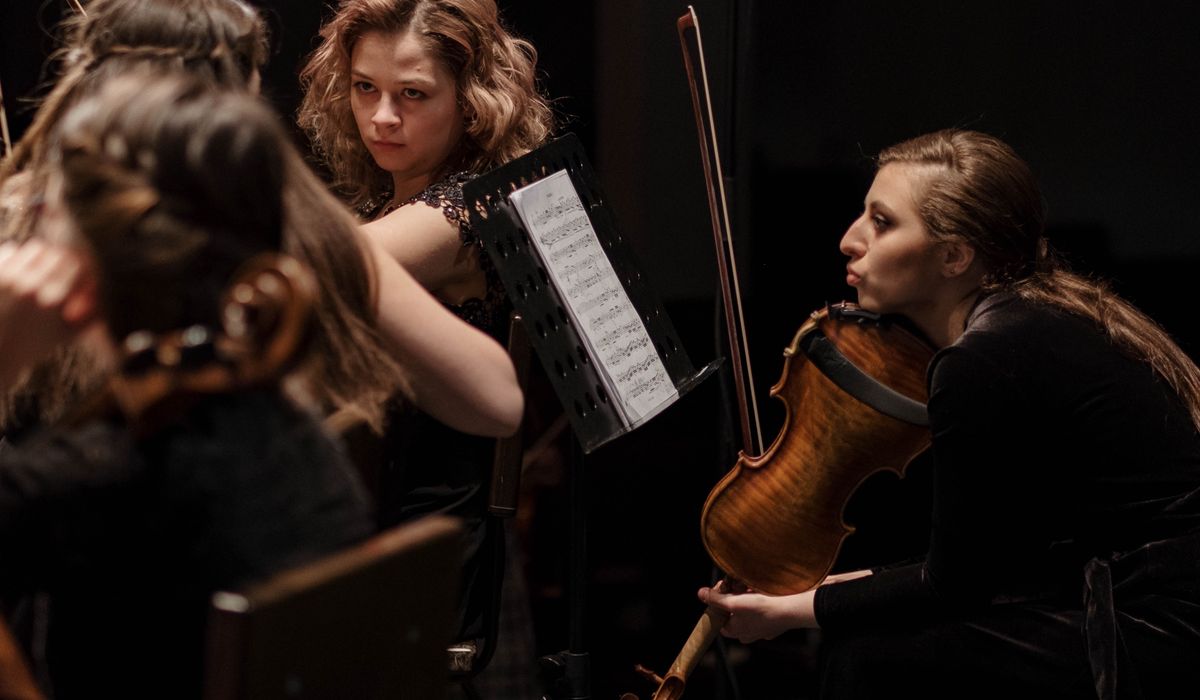
Three voices, one balance
A piano trio looks like a soloist with two helpers, and it seldom sounds like one. A modern concert grand is a small orchestra in a box: a single fortissimo chord can swamp a violin in its lower register and bury a cello in its middle one. Composers knew this, and so do the players. What you hear in a good performance is a negotiation, remade in every bar, between three musicians deciding who speaks and who listens.
Hearing that negotiation is one of the deeper pleasures of chamber music. It changes what you notice: not only the tunes, but how quickly a phrase passes from violin to cello, or how a pianist lifts a chord a fraction early so a cello line can surface beneath it.
Who has the melody, and who has the engine
Most trio writing moves through a handful of textures, and naming them sharpens the ear:
- Melody and accompaniment. The tune sits in one instrument while the other two supply harmony and pulse. Ask whether the accompaniment stays under the melody or pushes against it.
- Dialogue. Short phrases tossed between violin and cello, the piano providing the glue. Count the bars each player holds the idea.
- Three independent lines. Common in slow movements and fugal passages: every part has its own melody, and the ear must choose one to follow, then switch.
- Piano-led textures. The keyboard carries the argument while the strings add colour or punctuation, as in the first movements of many later Romantic trios.
Test yourself in a passage you know well: hum the tune. If you lose it for a few bars, it has probably passed to another instrument — and the interesting question is how gracefully the pianist let go.
The cello, the trio's quiet conscience
The cello is the instrument most often lost in performance and most often overlooked by listeners. Its upper register carries easily, but its middle and lower notes live in the same region as the piano's left hand — precisely where the pianist's temptation is to play generously. In Schubert's two trios and Brahms's three, the cello frequently holds the melody, sometimes alone, sometimes doubled by the violin an octave above. When the cello's line stays clear even in loud music, the balance is working.
A practical cue: sit where you can see the cellist's bowing arm. If you can watch the bow move but cannot hear a distinct pitch, the balance has tipped.
Where you sit, and what you hear
Balance is partly a matter of acoustics. In a chamber-scale hall the piano lid is usually propped on the short stick; with the lid fully open, the strings must work harder and the sound grows brighter. Seating matters just as much:
- Close and to one side: you hear the strings strongly and the piano's treble, but you may miss the cello's lower register and the piano's bass.
- Further back and central: the blend evens out, though some halls swallow the cello in the middle rows.
- Above the level of the players, if you can: you hear something closer to what the hall hears, which is what the trio is aiming at.
Where possible, hear the same trio twice from different places. Balance you assumed was the players' choice often turns out to be a property of your seat.
The piano's pedal and the strings' air
Pianists in trios talk about playing through the sound rather than over it. Two habits matter. First, the soft and sustaining pedals change the balance far more than most listeners realise: a chord held on the pedal keeps ringing underneath a violin line and can smear the harmony. Second, the piano's attack is instantaneous, while a string's sound blooms after the bow has moved. If the pianist plays exactly on the beat with the violinist, the violin can sound late.
Listen for this at the start of a slow movement: are the piano's chords placed a hair before or after the string entries? Either can be right. What matters is that it sounds intentional and consistent.
Putting your ear to the test
A few useful listening assignments for the curious:
- Beethoven's "Archduke" Trio, first movement: the theme is shared so evenly that you can follow it round the group like a relay baton.
- Schubert's Trio in E flat, second movement: the cello's melody against a steady piano tread — the classic test of cello audibility.
- Brahms's Trio in B, opening: broad piano chords against long string lines. Notice how the violin and cello stay warm without forcing.
- Ravel's Trio, first movement: asymmetrical rhythms and shifting colours, where balance is achieved by timbre rather than volume.
- Shostakovich's Trio in E minor, first movement: opening cello harmonics that can vanish entirely if the pianist is not careful.
Live performance teaches all of this faster than any recording, because you can watch the players' eyes. When a violinist glances towards the keyboard mid-phrase, that glance is the balance being adjusted in real time — and once you have heard it, it is very hard to unhear.

Joeby Ragpa
This template is so awesome. I didn’t expect so many features inside. E-commerce pages are very useful, you can launch your online store in few seconds. I will rate 5 stars.
ReplyAlexander Samokhin
This template is so awesome. I didn’t expect so many features inside. E-commerce pages are very useful, you can launch your online store in few seconds. I will rate 5 stars.
ReplyChris Root
This template is so awesome. I didn’t expect so many features inside. E-commerce pages are very useful, you can launch your online store in few seconds. I will rate 5 stars.
Reply